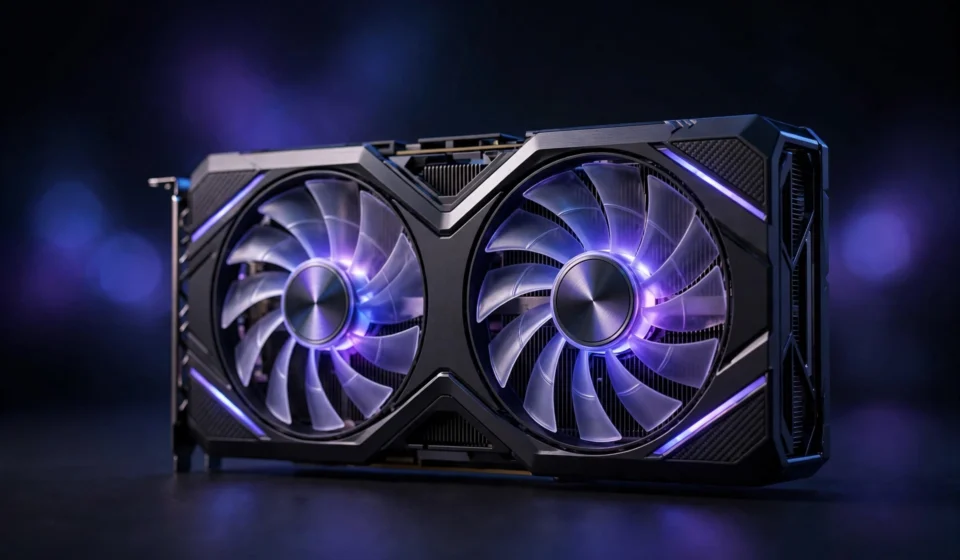

Shopping for the best graphics cards 2026 has to offer feels very different from a year ago. The GPU market has settled into three clear camps — Nvidia’s Blackwell RTX 50 series, AMD’s RDNA 4 lineup, and Intel’s Battlemage Arc cards — and a global memory shortage is pushing street prices well above official MSRPs. That means the “best” card is no longer simply the fastest one: value, VRAM capacity, and which upscaling features you get matter more than ever.
Whether you’re building a 4K battlestation, a compact 1440p machine, or a budget-friendly 1080p PC, there’s a card worth buying at almost every budget. This guide breaks down what to look for in 2026, then ranks the strongest options tier by tier so you can buy with confidence.
What defines the best graphics cards 2026 has on offer?
Before listing cards, it’s worth understanding how the market shifted. AI data-centre demand is competing with gaming GPUs for the same memory and wafer supply, which is why many cards sell far above their launch prices. Benchmarks from PC Gamer and Tom’s Guide show the RTX 5070 Ti, for example, selling for around $1,000 despite a $749 MSRP — prices have essentially moved up by one performance tier.
VRAM matters more than raw speed this year
If there’s one spec that separates cards that age gracefully from those that hit a wall, it’s video memory. Reviewers in 2026 broadly agree: 8GB cards should be treated as budget 1080p options, 12GB is a practical baseline for 1440p, and 16GB or more is the smart choice for 4K, heavy texture packs, and creator workloads. Modern AAA games at 1440p increasingly expose 8GB as a bottleneck, forcing texture downgrades or stuttering during asset streaming.
Upscaling is no longer optional
Nvidia’s DLSS 4 with multi-frame generation, AMD’s machine-learning-based FSR 4 (new to RDNA 4), and Intel’s XeSS are now genuine decision factors rather than nice extras. DLSS 4 remains the deepest and most widely supported, particularly for ray tracing and path-traced games. FSR 4 closed the quality gap significantly this generation, while XeSS has matured into a genuinely good option as game support expands. Nvidia also announced DLSS 5 — real-time neural rendering for RTX 50-series cards — at GTC 2026, expected to arrive in fall 2026.
Ray tracing is now mainstream
Ray tracing moved from enthusiast novelty to standard feature in 2026. Newer open-world RPGs and shooters ship with hybrid ray-traced lighting as a default mode, and even mid-range GPUs can now deliver playable ray tracing with upscaling assistance. Nvidia still leads in ray tracing quality, with AMD notably improved on RDNA 4 versus its older RDNA 3 cards.
The best graphics cards 2026: our top picks
1. Nvidia GeForce RTX 5070 Ti — best overall pick
The RTX 5070 Ti earns the top spot among the best graphics cards 2026 because it handles everything: high-refresh 1440p, capable 4K with DLSS 4 frame generation, strong ray tracing, and solid AI-workload versatility. Its 16GB of GDDR7 is comfortable for modern games and light creator work alike.
The catch is pricing. Officially $749, it now sells around $999 and beyond in many markets, per Tom’s Guide’s price tracking. That said, it’s still the most complete package if you want every showcase feature working at high refresh rates — and reviewers consistently rate it the sweet spot of the Blackwell stack.
2. AMD Radeon RX 9070 XT — best value for enthusiasts
For pure rasterisation performance per dollar, AMD’s RX 9070 XT is the enthusiast value champion. With 16GB of GDDR6 and notably improved ray tracing over RDNA 3, it’s a standout at its $599 MSRP — and while street prices have drifted upward, it remains cheaper than the RTX 5070 Ti while trading blows in non-ray-traced games.
FSR 4 upscaling is machine-learning based this generation and looks far better than FSR 3 ever did, narrowing one of AMD’s historical weaknesses. If you mainly care about maximum FPS for your money and can live without Nvidia’s AI toolkit, this is the card to beat.
3. AMD Radeon RX 9060 XT 16GB — best mid-range value
The 16GB RX 9060 XT is AMD’s first RDNA 4 mainstream card and immediately became the mid-range benchmark. Around $329 at MSRP, it delivers strong 1440p performance, 16GB of VRAM at a price where competitors still offer 8GB, and the improved FSR 4 upscaling.
It’s the card reviewers point budget-conscious buyers to in 2026: skip the 8GB version entirely, grab the 16GB model, and you have a card comfortable at 1440p that won’t run out of memory. Street prices have risen above MSRP at times, but it remains the value leader in its class.
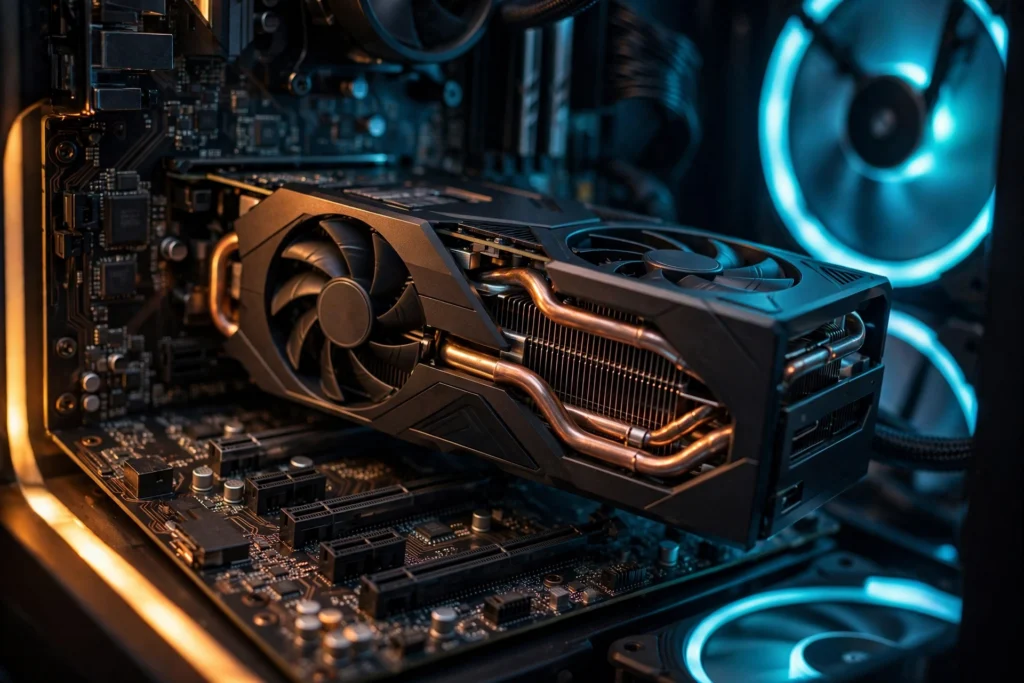
4. Nvidia GeForce RTX 5060 Ti 16GB — best Nvidia mid-range option
If you want Nvidia’s feature set — DLSS 4, better ray tracing, mature drivers — but can’t stretch to a 5070 Ti, the 16GB RTX 5060 Ti is the sensible pick. Officially $429, it typically sells between $430 and $570 depending on stock and region.
Like the RX 9060 XT, the rule is simple: buy the 16GB version, not the 8GB one. With that sorted, it’s a strong 1440p card with the full DLSS 4 experience and decent ray tracing for the price.
5. Intel Arc B580 — best budget graphics card 2026
Intel’s Battlemage B580 remains the best sub-$300 option in 2026. With 12GB of GDDR6 for around $250 at MSRP (typically $229–$289 in the market), it offers more VRAM than competing budget cards and mature, much-improved drivers after Intel’s sustained work on the Arc stack.
It’s a 1080p card first and foremost, with light 1440p capability and XeSS upscaling that reviewers now rate as genuinely good. Older DirectX 11 titles can occasionally show quirks, but anything modern runs fine. The even cheaper Arc B570 at around $200 is worth a look for the tightest budgets.
6. Nvidia GeForce RTX 5090 — best graphics card 2026, no compromises
The RTX 5090 is the best graphics card, period — if money is no object. Its 32GB of GDDR7, unmatched 4K and path-tracing performance, and leadership in AI workloads put it in a class of one. At roughly $1,999 and often much more in the current market, it’s priced for enthusiasts and professionals, not typical gamers. Most buyers will find the 5080 — around $999 — delivers high-refresh 4K without the flagship premium.
Best graphics cards 2026 by budget
To make the choice concrete, here’s how the tiers line up by what you’re actually likely to pay in late 2026:
Under $300 — 1080p gaming
The Intel Arc B570 (~$200) or Arc B580 (~$250) are the standout picks. Nvidia’s RTX 5060 appears near $260 at some retailers, but stock is inconsistent. At this budget, 12GB of VRAM on the Arc cards is a real advantage over 8GB alternatives.
$300–$500 — 1440p entry
This is where the RX 9060 XT 16GB dominates. At around $329–$450 in the current market, it’s the best combination of performance, VRAM, and price in the 2026 GPU market. The RTX 5060 Ti 16GB is the Nvidia alternative if DLSS 4 matters more to you than saving a little money.
$600–$800 — 1440p high refresh and ray tracing
The RX 9070 XT ($599 MSRP) leads for raster performance, while the RTX 5070 Ti — if you find it near the lower end of its $750–$1,000 street range — wins on features and ray tracing. AMD’s RX 9070 around $580–$630 sits between them.
$1,000 and up — 4K and creator work
The RTX 5080 (~$999) delivers high-refresh 4K in modern titles and leans on DLSS 4 multi-frame generation to stay smooth in path-traced games. The RTX 5090 (~$2,000+) is for those who run native 4K without upscaling or pair gaming with heavy AI workloads.
How to choose among the best graphics cards 2026
Start with your monitor. A 1080p display doesn’t need a $1,000 card, and a 4K 144Hz display will frustrate an 8GB budget GPU. Next, decide how you feel about upscaling: if you play the latest AAA titles and want them to look their best, DLSS 4 or FSR 4 support should factor into your choice.
Then weigh VRAM against price. In 2026’s inflated market, an extra 4GB of VRAM at the same price is worth more than a 5% speed advantage — memory headroom is what keeps a card comfortable for three or four years. Finally, check your power supply: flagship cards like the RTX 5090 can draw up to 575W, so budget for an appropriately rated PSU. Pairing your card with a capable display matters too — a good graphics card deserves a monitor that can show off its work, much like the portable machines in our guide to the best AI laptops 2026.
Final verdict on the best graphics cards 2026
The best graphics cards 2026 rewards careful shoppers. The RTX 5070 Ti is the most complete package, the RX 9070 XT is the enthusiast value king, and the 16GB RX 9060 XT is the mid-range card to beat. Prices are inflated across the board thanks to the memory shortage, so don’t overpay more than a modest premium over MSRP — sale events still bring prices down. And whatever you buy, make sure it has enough VRAM for your resolution: 12GB minimum for 1440p, 16GB for 4K, and steer clear of 8GB cards unless the budget truly demands it.
Frequently asked questions about the best graphics cards 2026
Should I buy Nvidia or AMD in 2026?
It depends on priorities. Nvidia’s RTX 50 series wins for ray tracing quality, DLSS 4 frame-generation depth, and AI workload versatility. AMD’s RX 9000 series wins for raster performance per dollar and VRAM at a given price. If you only game and want maximum FPS for the money, AMD is extremely competitive; if you want the best visual features and also run AI tools, Nvidia is the safer all-rounder.
Is 8GB of VRAM enough in 2026?
For 1080p esports titles and older games, yes. But for modern AAA games at 1440p, 8GB is increasingly a bottleneck. If you’re buying new in 2026, aim for 12GB minimum and 16GB if you want the card to stay comfortable for the next three to four years.
Why are GPU prices so high in 2026?
AI data-centre demand is crowding out gaming GPU and memory production at semiconductor fabs, driving up prices. Tom’s Hardware warned as early as late 2025 that graphics card prices would rise sharply through 2026, and street prices are now roughly one performance tier above launch MSRPs.
What’s the difference between DLSS 4 and FSR 4?
Both are upscaling and frame-generation technologies. DLSS 4 is Nvidia-exclusive, deeper in supported games, and pairs with stronger ray tracing hardware; FSR 4 is AMD’s new machine-learning approach for RDNA 4 that significantly improved on FSR 3 and works on AMD cards. Nvidia announced DLSS 5 with neural rendering at GTC 2026, arriving in fall 2026 for RTX 50-series cards.
Is the RTX 5070 Ti worth it over the RX 9070 XT?
If ray tracing quality, DLSS 4, and AI features matter to you, yes — the 5070 Ti is the more complete package. If you mainly want the most frames per dollar in traditional games and 16GB of VRAM, the RX 9070 XT delivers that for less. Both are strong 1440p and entry-level 4K cards.
Should I wait for prices to drop?
The memory shortage is expected to run through 2026 and into 2027, so there’s no strong reason to expect significant drops soon. If you need a card now, buy at or near MSRP during sale events and avoid paying more than a modest premium. If your current card still works, waiting until the shortage eases could save real money. For the full picture on current GPU rankings, see the tested roundup at Tom’s Guide.