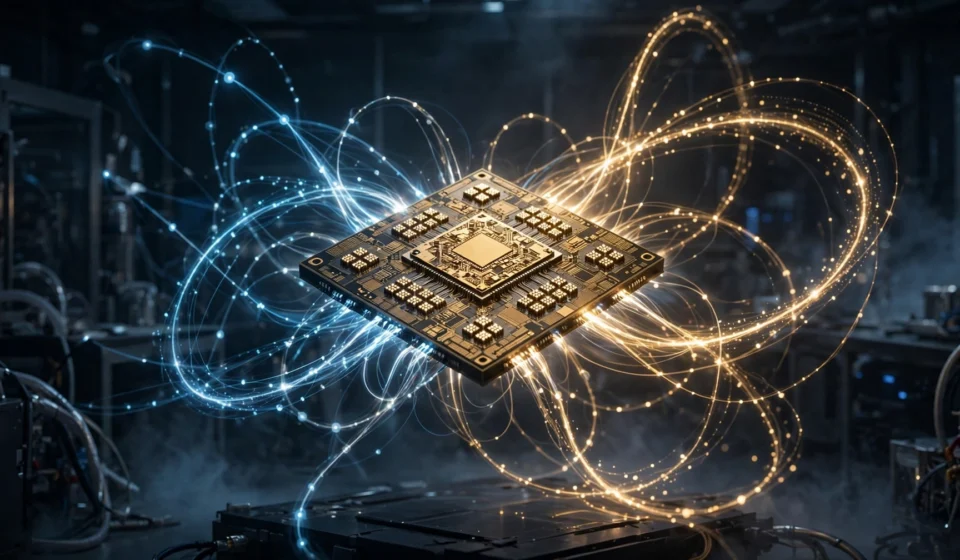

For decades, quantum computing was the technology that was always “ten years away.” In 2026, that joke is wearing thin. Across the industry, the biggest names in tech have begun to demonstrate quantum systems that do things classical computers genuinely struggle with — and investors, governments, and enterprises are paying close attention. Here’s a grounded look at where quantum computing stands in 2026, who’s leading, and what it could mean for the years ahead.
Why 2026 Is a Turning Point for Quantum Computing
Quantum computers manipulate information using qubits, which exploit quantum phenomena like superposition and entanglement to explore many possible solutions at once. The promise has always been enormous: simulations of molecules for drug discovery, optimization problems in logistics and finance, and cryptographic challenges that classical machines can’t touch.
The catch has been error correction. Qubits are fragile, and adding more of them historically added more errors. 2026 is the year that problem started to crack. The field’s most-watched milestone — below-threshold error correction, where scaling up qubits reduces errors instead of increasing them — was demonstrated on real hardware.
The Three Heavyweights: IBM, Google, and Microsoft
Google: Willow and the First Verifiable Quantum Advantage
Google’s 105-qubit Willow chip became the first quantum system to achieve below-threshold error correction. Scaling the chip’s surface code from a 3×3 to a 7×7 array cut the logical error rate roughly in half — an exponential reduction that proved scaling could now work in the field’s favor.
Google followed that with a headline demonstration: running its “Quantum Echoes” algorithm on Willow for a molecular-simulation task, reportedly 13,000× faster than classical supercomputers — a result Google described as the first verifiable quantum advantage, because the output could actually be checked.
IBM: Scaling Toward Quantum Advantage
IBM announced its 120-qubit Nighthawk processor was on track to demonstrate verified quantum advantage by the end of 2026 — reportedly hitting a 10x speedup in quantum error correction a full year ahead of schedule.
IBM’s longer arc is even more ambitious: the 1,386-qubit Kookaburra processor, expandable via multi-chip configurations, and the Starling system targeted for 2029 with 200 logical qubits running around 100 million error-corrected operations.
Microsoft: Topological Qubits With Majorana 1
Microsoft’s Majorana 1 processor is the world’s first quantum chip built on topological qubits — qubits whose quantum information is stored in a delocalized state that is inherently resistant to noise. Microsoft claims the technology could deliver practical quantum computers in “years, not decades.”
The Contenders Closing In
IonQ: The Fidelity Leader
Trapped-ion pioneer IonQ reported two-qubit gate fidelity exceeding 99.99% — the first quantum company to cross the “four nines” benchmark. Its roadmap calls for 10k-qubit single chips in 2027 and multi-module systems reaching millions of physical qubits by 2030.
Quantinuum: Logical Qubits That Beat Physical Ones
Quantinuum’s Helios system demonstrated 94 logical qubits that outperformed the underlying physical qubits — the long-sought “beyond break-even” point where error correction actually pays off.
PsiQuantum: The Photonic Bet
PsiQuantum raised $1 billion in September 2025 to build utility-scale photonic quantum computers, and partnered with Lockheed Martin — a signal its technology is maturing toward deployable systems.
China: Zuchongzhi 3.2 Crosses the Threshold
Chinese researchers became the second team in the world after Google to cross the fault-tolerant threshold, with their superconducting Zuchongzhi 3.2 system reaching the point where fixing errors made the system more stable.
Real-World Applications Coming Into Focus
Drug Discovery and Materials Science
Quantum computers excel at simulating quantum systems — which is exactly what molecules are. Pharmaceutical R&D could be shortened by years if quantum simulation can reliably model protein-ligand interactions.
Finance and Optimization
Portfolio optimization, risk analysis, and fraud detection are natural fits for quantum algorithms. Banks and investment firms are already running pilots.
Post-Quantum Cryptography
A sufficiently powerful quantum computer could break widely used encryption. The post-quantum cryptography market is projected to grow from about $1.9 billion in 2025 to $12.4 billion by 2035, and migration to quantum-safe algorithms is now a mainstream enterprise security project.

Cloud Access: Quantum-as-a-Service
IBM Quantum, Google Cloud, AWS (which introduced its first quantum chip, Ocelot), and Microsoft’s Azure Quantum all offer cloud access to real hardware. NVIDIA’s CUDA-Q framework ties quantum processors into GPU workflows, and hybrid quantum-classical approaches now dominate practical work.
What to Watch Next
The consensus timeline now points to fault-tolerant systems in the 2028–2030 window. The numbers that matter: logical qubit counts, error-correction overhead, and demonstrated applications with real economic value. For businesses, the practical advice from 2026 is consistent: start experimenting via the cloud, track logical-qubit milestones rather than raw qubit counts, and begin post-quantum cryptography migration now.
Frequently Asked Questions
What is quantum computing?
Quantum computing uses qubits — quantum bits that exploit superposition and entanglement — to perform certain calculations exponentially faster than classical computers. It targets problems like molecular simulation, optimization, and cryptography.
Which companies are leading quantum computing in 2026?
Google (Willow chip, below-threshold error correction), IBM (Nighthawk/Kookaburra roadmap toward quantum advantage), and Microsoft (Majorana 1 topological qubits) lead, with strong contenders in IonQ, Quantinuum, PsiQuantum, and AWS.
What is below-threshold error correction?
It’s the point where adding more qubits to an error-correcting code decreases the overall error rate rather than increasing it. Google’s Willow demonstrated this in 2026.
When will quantum computers be useful for businesses?
Early practical applications are emerging now via cloud platforms. The industry consensus targets fault-tolerant systems between 2028 and 2030.
Should companies worry about quantum breaking their encryption?
Not immediately, but planning is prudent. Migration to post-quantum cryptography standards is underway, and the PQC market is projected to grow from about $1.9 billion in 2025 to $12.4 billion by 2035.
How can I experiment with quantum computing today?
Through cloud services: IBM Quantum, Google Cloud, AWS Braket, and Azure Quantum all offer access to real quantum hardware.



[…] And if you’re curious how fast the underlying technology is moving, our look at quantum computing in 2026 shows where chip design is headed […]