

The best soundbars 2026 has on the shelves can turn a flat, tinny TV into something that sounds like a cinema — no AV receiver, no speaker wire, no dedicated room required. But buying the wrong one is remarkably easy: a flagship 11.1.4 system in a small bedroom wastes its rear and ceiling channels, while a slim 2.1 bar in a big open-plan living room leaves films feeling small. This guide matches the top soundbars of 2026 to real rooms and budgets, so you buy the bar that actually suits your home.
Best Soundbars 2026: Our Top Picks
Here are the standout models from this year’s reviews, arranged by what each one does best.
Best Overall Soundbar 2026: Sonos Arc Ultra
For most living rooms, the Sonos Arc Ultra is the bar to beat in 2026. It packs a 9.1.4 speaker array — including upward-firing drivers for Dolby Atmos height effects — into a single slim cabinet, and reviewers consistently praise its scale and bass output for a one-box solution. Sonos’ Trueplay room tuning adapts the sound to your space, and it streams over Wi-Fi, Bluetooth, and AirPlay 2. It doubles as a genuinely good music speaker, which is not true of every soundbar. The main caveats noted by reviewers: it skips DTS:X support and has no HDMI passthrough, so check your setup if those matter to you. Explore the range on Sonos’ official site.
Best Surround Sound System: Samsung HW-Q990F
If you want the full cinema experience with real sound wrapping around the room, Samsung’s flagship HW-Q990F is the system reviewers keep recommending. It delivers a genuine 11.1.4-channel experience with wireless rear speakers and a separate subwoofer in the box, and Samsung’s Q-Symphony feature lets compatible Samsung TV speakers join in for extra immersion. It is the pick for dedicated home-cinema rooms where a single bar is not enough.
Best Premium Single Bar: Sennheiser Ambeo Soundbar Max
Trusted Reviews names the Sennheiser Ambeo Soundbar Max its best overall soundbar, and it is easy to see why: it is designed to reproduce a full surround effect from a single large enclosure, with outstanding measured performance for both films and music. It is big, heavy, and expensive — but if you refuse to add rear speakers yet demand flagship sound, it is the reference.
Best Compact Soundbar: Sonos Beam (Gen 2)
The Sonos Beam Gen 2 is the set-and-forget answer for small to medium rooms. At roughly half the size of the Arc Ultra, it still supports Dolby Atmos through virtualization, sounds far bigger than its footprint, and slots neatly under TVs up to about 55 inches. For bedrooms, apartments, and anyone who wants great TV sound without rearranging furniture, it is the sweet spot.
Best Mid-Range Value: Samsung HW-Q800D
Samsung’s mid-range HW-Q800D pairs a 5.1.2-channel bar with a wireless subwoofer for properly cinematic sound at a fraction of the flagship price. It includes SpaceFit Sound room calibration and works with Samsung’s Q-Symphony if you own a recent Samsung TV. Reviewers rate it as one of the strongest price-to-performance picks of the year.
Best Budget Soundbar: Sony HT-SF150
For under the price of a nice dinner, the Sony HT-SF150 is the classic “better than TV speakers” upgrade. It is a simple 2.1-channel bar with a bass-reflex design for clearer dialogue and fuller sound, connects over Bluetooth as well as HDMI ARC, and fits anywhere. It will not do Atmos or shake the room, but it transforms everyday TV watching for very little money.
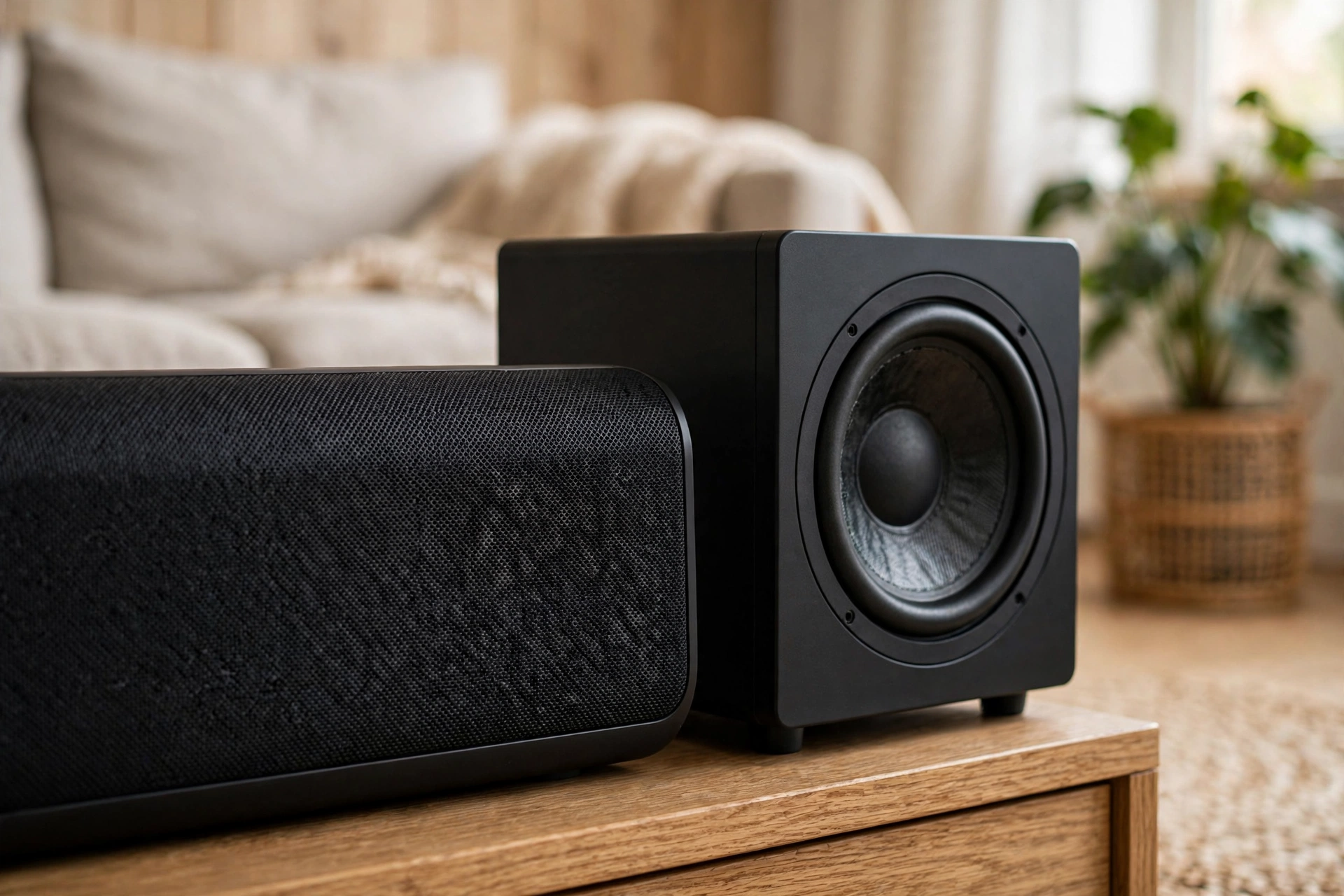
Best Soundbars 2026: Match the Bar to Your Room
The number-one buying mistake reviewers flag is shopping by spec sheet instead of room. A useful rule of thumb:
- Small bedroom or studio: a 2.1 or 3.1 bar with no rear satellites — Sonos Beam Gen 2, Bose Smart Soundbar, or Sony HT-SF150.
- Typical living room: a 3.1.2 or 5.1 bar where rear surrounds become genuinely useful — Sonos Arc Ultra, Samsung HW-Q800D.
- Large or open-plan room: a full 5.1.4 system with discrete rears and a separate subwoofer — Samsung HW-Q990F.
If you are unsure between sizes, size down. A great 3.1 soundbar that fits your room beats a misconfigured 5.1.4 system every time.
What to Look for in a Soundbar
HDMI eARC vs ARC
Always connect your soundbar through HDMI ARC or, preferably, eARC. eARC passes lossless, full-bandwidth Dolby Atmos from your TV, while plain ARC limits you to compressed audio. Before buying, confirm your TV has the matching port — most TVs from the last few years have eARC, but it is worth checking.
Dolby Atmos: real vs virtual
True Atmos needs upward-firing drivers (like the Arc Ultra’s) or discrete height speakers (like the HW-Q990F’s rears) to create the overhead effect. Many compact bars offer “virtual” Atmos through processing alone — it can sound convincing in small rooms, but it is not the same as physical height channels. Match your expectations to your room size.
Room calibration
Bars with automatic room tuning — Sonos Trueplay, Samsung SpaceFit Sound — measure your room’s acoustics and adjust the sound accordingly. This matters more than most spec-sheet numbers, because the same bar can sound dramatically different in a carpeted bedroom versus a tiled open-plan kitchen.
Music and multi-room
If your soundbar will double as your main music speaker, lean toward brands with strong music ecosystems. Sonos bars integrate with the whole Sonos multi-room system and support Wi-Fi streaming, AirPlay 2, and voice assistants — a meaningful advantage if you already own smart speakers. Our guide to the best smart speakers 2026 covers the best companions for a multi-room setup.
Gaming features
Gamers should look for HDMI 2.1 passthrough on the bar so consoles can use 4K/120Hz and variable refresh rate without going through the TV’s limited ports. Samsung’s higher-end bars and the Razer Leviathan V2 (designed with PC gamers in mind) are the gaming-friendly picks for 2026.
FAQ: Best Soundbars 2026
Are soundbars worth it in 2026?
Yes. Almost any dedicated soundbar — even a budget model — sounds dramatically better than the thin built-in speakers of a modern flat-screen TV, with clearer dialogue and much fuller sound. It is one of the highest-impact upgrades you can make to a home entertainment setup.
What is the difference between 2.1, 5.1, and 5.1.4 soundbars?
The numbers describe channels: the first is the main channels (left, center, right, surrounds), the second is whether a subwoofer is included (.1), and the third — where present — is the number of overhead or height channels for Dolby Atmos (.4). A 2.1 bar is a stereo bar plus sub; a 5.1.4 system adds surround and height speakers for full immersive audio.
Do I need a subwoofer with a soundbar?
For films, a subwoofer makes a bigger difference than almost any other upgrade — it handles explosions, music bass, and the weight in voices. Premium all-in-one bars like the Sonos Arc Ultra produce impressive bass from a single cabinet, but a system with a separate wireless sub (like the Samsung HW-Q990F) still wins for true cinema impact.
Can a soundbar replace a full home theater system?
For most people, yes. A good 5.1.4 soundbar system delivers a genuinely cinematic experience with far less complexity, wiring, and cost than a receiver with separate speakers. Dedicated home-theater setups still win at the very high end, but the gap keeps shrinking every year.
Will a soundbar work with any TV?
Any TV with an HDMI ARC or optical audio output works with any soundbar. For the best quality, use HDMI eARC, which passes full Dolby Atmos. Also consider buying the same brand as your TV: Samsung’s Q-Symphony, LG’s WOW Orchestra, and Sony’s voice-zoom features only work within one manufacturer’s ecosystem.
Should I wall-mount my soundbar or put it on a stand?
Either works, but keep the bar at ear level and unobstructed. If you wall-mount your TV, wall-mounting the bar just below it keeps everything aligned and tidy — Samsung’s HW-QS90H is designed with a particularly slim wall-mount profile. Soundbars placed inside a cabinet can sound muffled, so keep the front of the bar clear.